How to Build a Wine Education Program In-Store: Turning Staff Knowledge Into a Competitive Advantage
By Intentionally Creative, Editorial Team13 min read
Listen to this article16:11
Schedule a free strategy call and Intentionally Creative will build a custom plan for you.
Schedule Your Free Strategy CallFree audit. No commitment.
Get a Free Audit. No commitment.
Learn how to build a wine education program for your liquor store that boosts sales, builds customer trust, and gives you an edge over big-box competitors.
Your biggest competitor just opened a store the size of a small aircraft hangar. They've got 8,000 wine SKUs, slick signage, and a parking lot that could host a county fair. You've got 1,200 square feet and a staff of six. On paper, you lose.
But here's what the big-box playbook misses: most customers don't walk into a wine aisle knowing what they want. They walk in hoping someone will help them figure it out. And that's where a well-built wine education program in your liquor store turns your smallest advantage, your people, into your biggest one. Knowledgeable staff don't just answer questions. They build trust, drive higher-margin sales, and create the kind of experience that keeps customers coming back past the mega-store on their way to you.
This guide lays out exactly how to make that happen, from choosing the right training resources to structuring a tiered program that scales, running weekly sessions that actually stick, and measuring whether it's all paying off. No sommelier budget required. Just a system, some curiosity, and one open bottle a week.
Let's be honest about the competitive landscape. Then let's talk about why it actually works in your favor.
Total Wine just opened a 22,000-square-foot location in Westwood Village. That's not a store, that's a warehouse with mood lighting.
You're never going to match that footprint. You're never going to carry 8,000 SKUs of wine. And here's the thing: you don't need to.
Learn how email segmentation for liquor stores drives repeat sales with a 4,200% ROI. List-building tactics, purchase...
Because selection without guidance is just a wall of labels. And a wall of labels overwhelms customers, it doesn't serve them.
Any experienced distributor rep will tell you the same thing: well-equipped staff drive more sales and deeper customer trust than shelf space alone. Confidence sells. A team member who can walk someone from "I need a red wine for dinner" to the perfect $18 Côtes du Rhône in under two minutes? That's a conversion machine no planogram can replicate.
What customers want is simple: they want to feel smart about what they're buying. They want someone to cut through the noise, make a genuine recommendation, and maybe teach them something they'll repeat at the dinner table.
Independent liquor stores that invest in staff wine knowledge create exactly that experience, personalized, human, trustworthy. Big-box retailers can't fake it.
This is why a wine education program in your liquor store isn't a cost center. It's a marketing strategy, arguably the highest-ROI investment most store owners aren't making.
Learn how to run compliant, high-performing Google Ads for liquor stores. Covers campaign setup, bidding strategies, ...
The time commitment is real but manageable. Wine Folly's beginner course takes just a few hours. WSET offers structured certifications across four levels, giving you a clear framework to build staff development tiers over time. You don't need sommeliers overnight. You need curious people who know more today than they did last month.
That's the edge. Employee wine knowledge compounds, every conversation builds loyalty that no square footage can buy.
So the case is clear: expertise beats shelf space. The next question is practical, what does a training program actually look like when you're running a retail operation, not a wine school?
Here's the truth: you don't need a master sommelier on payroll. You need a system, something structured enough to build real knowledge but flexible enough to work in a retail environment where the register doesn't stop ringing.
Let's break down your options.
12 wine and spirits content marketing ideas for liquor stores that drive foot traffic, boost engagement, and move inv...
The Wine & Spirit Education Trust (WSET) offers four certification levels, from foundational (Level 1) through diploma (Level 4), covering wine, spirits, beer, and sake. What makes this valuable for retailers is the built-in progression. You can map it directly to staff development tiers: Level 1 for new hires, Level 2 for floor leads, Level 3 and beyond for department managers.
This isn't theoretical. Binny's Beverage Depot has partnered with American Wine School to offer WSET-level education to both staff and customers, proving this model works at scale in retail, not just in restaurants or wine bars.
Not ready for formal certification? That's fine. Wine Folly offers trade-specific courses that work as practical benchmarks. Their Wine 101 takes only a few hours, even your busiest employee can knock it out in a single slow afternoon. Wine 201 takes several days, making it a solid next step for motivated team members.
For something built specifically for your world, Graff Retail offers a fully customizable sales training program designed for wine and liquor retail, delivered via mobile app and desktop. Your staff can build product knowledge between customers, not just in a classroom.
The goal isn't creating walking encyclopedias. It's building practical competence and genuine confidence on the sales floor, the kind that turns browsers into buyers.
Now that you know what's available, the question becomes: how do you roll this out without trying to turn every employee into a wine expert at once? The answer is tiers.
Here's the thing about building a wine education program: you don't need every employee to pass a sommelier exam. You need a system where someone on the floor always has the answer. That's the difference between a program that works and one that burns everyone out by week three.
A tiered approach gets you there without overwhelming your team, or your budget.
Every employee, yes, including cashiers, should be able to handle the five questions customers ask most: red vs. white basics, popular varietals, simple food pairing starting points, price-to-quality guidance, and how to read a wine label. That's it. No deep dives, no obscure regions.
Wine Folly's Wine 101 is a realistic week-one assignment even for part-timers. This baseline ensures no customer ever hits a dead end at your register.
Your floor staff need more. They should know your store's key regions, understand basic tasting methodology, and, critically, be able to upsell a customer from a $12 bottle to a $25 bottle with a real reason why. Not "this one's better." More like, "this Côtes du Rhône has the same dark fruit profile you like, but with more complexity and a longer finish."
The format that works? Weekly 15-minute team sessions on specific topics, pairing principles, regional spotlights, new arrivals. Reddit's wine retail community consistently points to these short, focused sessions as the most sustainable approach. Wine Folly's intermediate course (Wine 201) gives you a realistic benchmark for this phase, several days of material you can spread across the quarter.
Pick your top one or two people and invest in WSET Level 1 or Level 2 certification. The structured progression gives your team a visible career path, not just another task on the to-do list.
Once your staff knows their Sancerre from their Sauvignon Blanc, it's time to flip the model outward. A wine education program in your liquor store shouldn't stop at the employee level, it should become the reason customers choose you over the big-box alternative down the road.
Binny's gets this. They offer WSET-level education directly to customers, transforming their stores from transaction points into destinations. That's a competitive moat no amount of shelf space can replicate.
You don't need a sommelier on retainer. A monthly guided tasting, four or five wines around a theme like "Under $15 Italian Reds" or "Wines That Pair With Takeout", builds community, drives foot traffic on slow weeknights, and creates social media content that actually performs. These events also generate email list signups, repeat visits, and higher average transaction values, the trifecta of wine retail competitive advantage.
Raley's, a supermarket chain, is actively investing in beverage alcohol credentials for its staff in 2025. If grocery stores see in-store wine education as a battleground worth fighting on, independent retailers can't afford to sit this out. Someone in your market will build this muscle. Make sure it's you.
No tastings allowed? You're not off the hook. Utah's state liquor stores piloted wine education courses for customers, no tastings whatsoever, because state law wouldn't allow it, and still built measurable customer engagement. They used structured classroom-style sessions covering regions, grape varieties, and food pairing principles.
If Utah can do it, you can do it. Education doesn't require a corkscrew. It requires intention.
All of this effort raises a fair question: how do you know it's actually working? You don't need to guess. A few straightforward metrics will tell you everything.
Track average bottle price sold per staff member before and after training. Even a $2–3 increase per transaction compounds fast across hundreds of weekly sales. That's potentially $600–900 in additional weekly revenue from one metric alone.
Monitor wine category revenue as a percentage of total sales. A rising share means your team is actively guiding customers, not just pointing at shelves. This is how a wine education program at your liquor store pays for itself.
Are customers asking for specific staff members by name? Are Google reviews mentioning helpful recommendations? These leading indicators show your training investment is becoming a genuine competitive advantage, the kind that big-box competitors can't replicate with shelf space alone.
Set a 90-day checkpoint. If average transaction value or customer feedback isn't moving, adjust the format, not the commitment.
The data will confirm what your gut already knows: knowledgeable staff sell more wine. Now there's only one thing left, actually starting.
You don't need permission to start. You need momentum. Here's how to build it in three concrete steps.
Move 1: Quiz your team (casually). Put together 10 low-pressure questions covering major grape varietals, key regions, and basic food pairings. No grades, no judgment, just a snapshot. This tells you exactly where your training program needs to begin.
Move 2: Create an internal champion. Sign up your most motivated team member for Wine Folly's Wine 101 course. It takes just a few hours, not weeks, and suddenly you have someone who can help teach the rest.
These specialists become your in-house authorities, your tasting event hosts, and frankly, your competitive moat. You're never going to out-shelf a big-box competitor. But you can out-know them, and that's where staff expertise becomes a genuine strategic advantage.
The beauty of this tiered model? You're building a team, not cloning wine experts. Someone always has the answer. That's the whole game.
Structure is essential, but even the best framework falls apart without a rhythm your team can actually maintain. Here's how to make education a habit, not a burden.
Here's the truth about wine staff training in retail: nobody's got time for a two-hour seminar on Burgundy classifications. Your staff is busy. You're busy. And the moment training feels like a college lecture, eyes glaze over and nothing sticks.
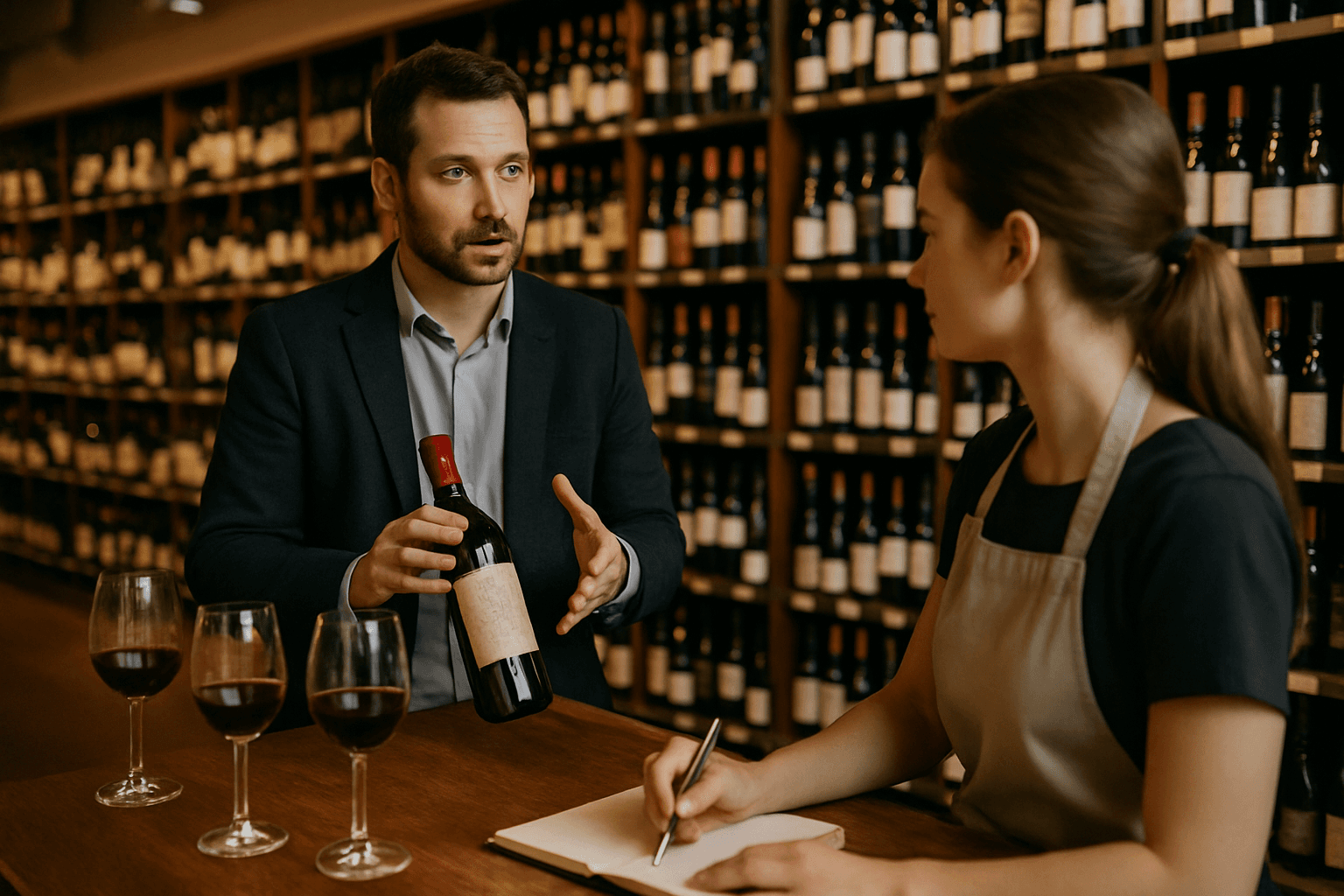
The good news? The most effective training doesn't happen in a classroom. It happens in 15-minute bursts before a shift, with an open bottle and a single focused topic.
Pick one thing. One region. One grape. One price tier comparison. That's it. Open a bottle, pour small tastes, and talk about it for 15 minutes before the floor gets busy. Then give your team 2–3 talking points they can use with customers that same day.
Keep a shared doc or whiteboard labeled "This Week's Pick" with those talking points. This turns education into immediate sales language, not abstract knowledge that lives in someone's head and never reaches the register.
You're essentially breaking a full beginner wine course into digestible daily pieces your team actually retains. Reddit wine retail managers back this up: combining general concept training with focused sessions on specifics like pairing principles and regional specialties is what actually sticks.
Your distributor reps are the most underused resource in building staff wine knowledge. Invite them to lead a focused 15-minute session on their portfolio highlights. They get valuable face time with your team, your staff gets expert-level knowledge, and you pay absolutely nothing.
This matters more than ever as big-box competitors expand aggressively. You can't compete on selection. You compete on expertise, the kind that comes from a team that actually knows what they're recommending. That's your edge, and it costs you 15 minutes a day.
At some point, your team's growing expertise starts to feel like a secret only your staff and your regulars know about. That's when it's time to turn the program outward, and let education become the reason new customers walk through your door.
Intentionally Creative specializes in digital marketing strategies that drive real results. Let us show you what's possible.
Schedule a CallMove 3: Schedule a 15-minute pre-shift tasting for next week. Pick one bottle you want to move more of. Open it, taste it together, and give the team three talking points to use with customers.
That's it. One bottle, one conversation, one decision: your store competes on brains, not shelf space.
A wine education program in your liquor store isn't about turning your team into wine scholars. It's about building the one advantage that can't be copied by a competitor with deeper pockets and more square footage: genuine human expertise that customers trust.
The playbook is simple. Start with a baseline quiz. Get one person trained. Open one bottle before a shift. Then do it again next week. Within 90 days, you'll have a team that sells with confidence, customers who come back because they learned something, and a store that stands apart in a market where everyone else is competing on price and selection alone.
You don't need 22,000 square feet. You need 15 minutes and a corkscrew.
Pick one of the three moves above and do it before the week is out. Your future regulars are waiting.