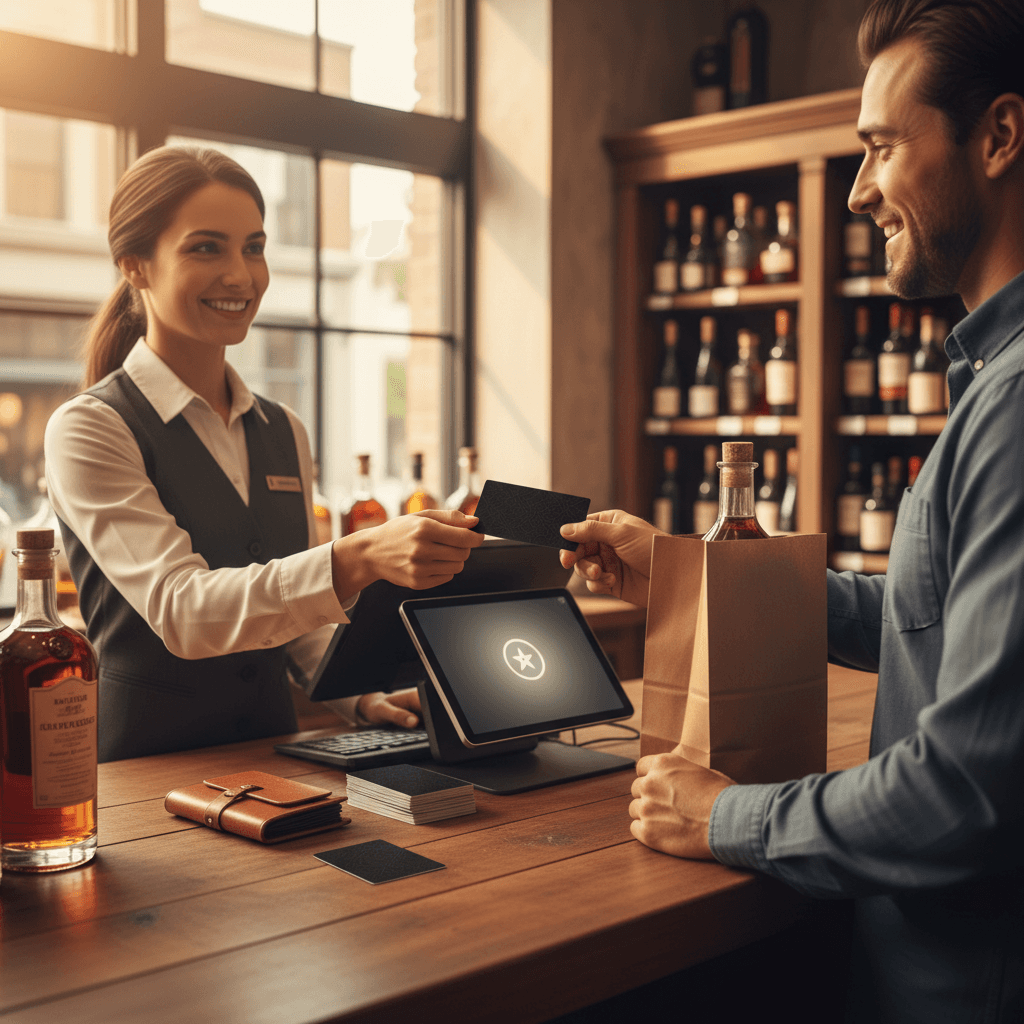
How to Create a Liquor Store Loyalty Program: Structures, Legal Rules, and Software That Actually Work
By Intentionally Creative, Editorial Team13 min read
Listen to this article17:57
Schedule a free strategy call and Intentionally Creative will build a custom plan for you.
Schedule Your Free Strategy CallFree audit. No commitment.
Get a Free Audit. No commitment.
Learn how to build a liquor store loyalty program that drives repeat sales. Covers program structures, state legal rules, and the best software for indie retailers.
Every week, your best customers walk out the door and into a competitor's rewards program. Maybe it's Total Wine's points system. Maybe it's the grocery store's fuel perks. Maybe it's a cash-back deal they saw on their phone at 7-Eleven. The point is, someone else is getting credit for the relationship you built, because they built the system to capture it.
A liquor store loyalty program isn't about slapping a punch card next to the register and hoping for the best. Done right, it's a structured, margin-aware engine that turns occasional buyers into regulars and regulars into advocates. Done wrong, or not done at all, it's a slow leak of revenue you'll never see on a P&L statement.
This guide covers everything you need to build a program that actually works: the four main structures and when to use each one, the state-by-state legal landmines that trip up even experienced operators, the software platforms worth your money, and a launch plan designed for stores that don't have a corporate marketing department. Whether you're running a single location or a small chain, this is the playbook.
Let's cut to it: your customers already belong to someone else's loyalty program. Probably several. The question isn't whether a rewards program makes sense for your business, it's how long you can afford to operate without one.
Total Wine's &MORE Rewards. Spec's Key Club. Goody Goody's Bottle Club Rewards. BevMo!'s ClubBev!. These programs have trained millions of alcohol buyers to expect points, perks, and personalized deals every time they purchase a bottle. Your store is competing with that expectation whether you've built a program or not.
Discover proven liquor store customer retention tactics to build loyalty, increase profitability through repeat custo...
And it's not just the big liquor chains anymore. In 2025, 7-Eleven partnered with Swiftly to roll out alcohol cash-back deals across 10,000+ locations [VERIFY, confirm timing and scope of rollout]. When convenience stores are investing in alcohol retail loyalty, the bar has officially been raised for every retailer in the space.
Meanwhile, programs like Hazel's Beverage World's Frequent Flyer, running continuously since 2012 [VERIFY], prove that a well-built loyalty program isn't a fad. It's infrastructure.
Here's where skepticism meets data: industry-wide redemption rates for retail loyalty programs sit between 20–40% [VERIFY, sourced to Scotch POS; cross-check with additional sources]. That means a well-designed program generates real, measurable engagement, not just a signup list collecting dust in your POS system.
But this article isn't about copying Total Wine's playbook. It's about building a right-sized program that drives repeat visits, increases basket size, and doesn't eat your margins alive. Let's get into how.
Stop leaving online sales on the table. Here are the 10 most costly e-commerce mistakes liquor stores make and how to...
Now that the "why" is settled, the next decision is structural. Not every program needs to look the same. The best structure depends on your customer base, your margins, and honestly, how much complexity you're willing to manage. Here's a breakdown of the four most common models, and where each one shines.
Customers earn points per dollar spent, then redeem them for discounts or free items. It's the default for most POS-integrated loyalty platforms, and for good reason: it's easy for customers to understand and easy for you to automate.
Points-based systems also give you flexibility. You can run double-point promotions on slow days, bonus points on specific categories, or seasonal accelerators, all without changing your core program. And because most earned points never get redeemed (industry redemption rates hover in the 20–40% range), a chunk of that liability stays on paper rather than hitting your margins.
Tiered programs unlock better rewards at higher spending levels, think Bronze, Silver, Gold. This model works especially well for stores with a wide range of price points because it encourages trading up. A customer sitting at Silver who's $50 away from Gold will often grab that premium bottle instead of the well brand.
Discover 10 proven SMS marketing strategies for liquor stores that drive customer loyalty. Learn compliance tips, seg...
Study how Total Wine and Spec's structure their tiers for inspiration. You don't need their scale, just their logic.
The simplest rewards program out there: "Buy 10, get 1 free" or "$10 back for every $100 spent." No app required, no POS integration necessary. It works, and it's analog-friendly for stores that aren't ready to go digital.
One word of caution: that 10% reward rate ($10 back per $100 spent) is common among small liquor stores, but it's been actively debated in communities like Reddit's r/smallbusiness for its long-term margin sustainability. Run your own numbers before committing, a 5% rate might be more realistic depending on your product mix.
Cash-back is growing fast in alcohol retail loyalty, largely thanks to digital platforms making it seamless. Rewards show up as statement credits or store credit rather than traditional discounts. This model works particularly well in states where direct discounting on alcohol is legally restricted, you're rewarding the customer without technically reducing the sale price.
The scale potential is real: 7-Eleven's Swiftly-powered alcohol cash-back program spans thousands of locations, signaling that major players see this model as the future.
| Model | Complexity | Estimated Cost to Run | Best Fit |
|---|---|---|---|
| Points-Based | Low, Medium | Low (~$0–50/mo if POS-integrated) | Any store size; best all-around starting point |
| Tiered | Medium, High | Medium (~$50–150/mo+) | Mid-to-large stores with diverse price ranges |
| Punch Card / Spend-Threshold | Very Low | Minimal (physical cards only) | Small stores, single-location operators |
| Cash-Back | Medium | Medium (~$50–150/mo+) | Stores in discount-restricted states; digitally savvy customers |
The bottom line: the best program is the one you'll actually maintain. Pick the structure that matches your operations today, and build from there.
You've picked a structure. Now comes the part most liquor store owners skip, and the part that can get you in the most trouble.
Your liquor store loyalty program lives or dies by what your state's alcohol laws permit. Get this wrong, and you're not just losing a marketing program, you're risking your license.
Legal considerations vary dramatically by state. Control states like Pennsylvania, Utah, and Virginia, along with states that enforce strict tied-house laws, often have the most restrictive rules around alcohol pricing. Some states prohibit discounting on alcohol entirely, which means your rewards program cannot offer dollar-off rewards or percentage discounts on booze. Period.
Even in more permissive states, there are often guardrails: limits on coupon values, restrictions on buy-one-get-one offers, or rules about how discounts can be advertised. Your state's ABC (Alcoholic Beverage Control) board is the definitive source here, not a blog post, not a Reddit thread, not what your buddy in another state does.
Plenty of successful programs operate in restrictive states. They just structure rewards differently. Platforms like Loyal-n-Save emphasize compliance features, including age verification checks and digital rewards designed to meet state-level alcohol regulations. Choosing the right tech genuinely reduces your legal exposure.
For context, Hazel's Frequent Flyer program has navigated over 13 years of evolving regulations. Longevity like that requires getting the legal foundation right from day one.
If your state limits discounting, pivot. Some of the most effective loyalty strategies don't involve price reductions at all:
Structures, legal frameworks, and software comparisons are useful, but nothing replaces seeing what's actually working on the ground.
Hazel's Beverage World in Boulder, Colorado [VERIFY, confirm location] launched its Frequent Flyer program back in 2012. It's still running today, over 13 years of continuous operation. No rebrand. No overhaul. No "Loyalty Program 2.0."
The program offers members instant savings. That's it. No complicated tier unlocks, no app downloads, no gamified badge system. Their staff can explain it in one sentence. Their customers understand it immediately.
The key takeaway: consistency beats complexity. They built a program their team could actually run day after day, year after year. A dead loyalty program, one that launches with fanfare and fizzles by month six, is genuinely worse than having no program at all.
The big chains offer useful blueprints, if you adapt the principle rather than the budget. Total Wine's tiered approach works because they have massive product assortment to reward exploration. Goody Goody's Bottle Club creates exclusivity around allocated bottles.
You don't need 10,000 locations. You can create a "first access" list for allocated bourbons with nothing more than a spreadsheet and a text message. That kind of program costs almost nothing but builds the kind of customer loyalty money can't buy.
You've seen the models, checked the legal landscape, evaluated the software, and studied what works in the real world. Now it's time to actually do it. Here's how to get a program live without turning it into a six-month project.
Here's your five-step launch plan:
Remember Hazel's: they didn't start with a complex tier system. They started simple and iterated over 13 years.
The 10% return ($10 back per $100 spent) is a common starting point, but it's worth stress-testing against your actual margins before you commit.
Here's the reality: not every dollar you promise actually walks out the door (remember those 20–40% redemption rates). But if your program gains traction and redemption climbs, a 10% reward rate on already-thin margins can hurt.
A 5% reward with high engagement often outperforms a 10% reward that bleeds profit. Pull your POS data, look at your average basket size and margin by category, and model the impact. If you're averaging 25% gross margins, a 10% reward eats nearly half your profit on redeemed transactions. At 5%, you're building real customer loyalty while keeping the math sustainable.
These perks build genuine loyalty without touching a price tag.
One strong recommendation: consult a local attorney familiar with your state's liquor laws before finalizing your program terms. This is not a DIY legal situation. The cost of a few hours of legal counsel is nothing compared to the cost of a violation.
With your structure chosen and your legal guardrails in place, it's time to pick the technology that brings it all together. You don't need enterprise-grade tech, but you do need something your staff will actually use every shift. Here's how the landscape breaks down.
For single-location retailers, POS-integrated loyalty is the dominant model, and for good reason. It eliminates double data entry, tracks customer behavior automatically, and means one less system to manage.
The leading options worth evaluating:
If your POS loyalty features feel limiting, Loyal-n-Save deserves a look. It offers scan data integration and compliance-focused features designed for alcohol retailers who want more sophisticated program management, customer segmentation, targeted promotions, and reporting that goes deeper than most POS dashboards allow.
Regardless of which direction you go, evaluate any platform against these non-negotiables:
That last point matters most. If your team can't run the system without you standing over their shoulder, it won't survive your first vacation. The best loyalty tool is the one your newest employee can learn in a single shift.
Intentionally Creative specializes in loyalty programs strategies that drive real results. Let us show you what's possible.
Schedule a CallThis is the make-or-break factor. Full stop.
If your cashiers don't ask every customer to join, your program will flatline, no matter how generous the rewards are. Make enrollment part of the checkout script, not optional, not "when they remember."
Consider a small staff incentive for signups during the first 90 days. Even $1 per enrollment or a monthly bonus for the top-enrolling cashier changes behavior fast. Your team needs to feel like the program is theirs to champion, not just another thing management dreamed up.
A liquor store loyalty program isn't a perk, it's customer retention infrastructure. Every repeat visit your program drives is one that didn't go to Total Wine, the grocery aisle, or an online retailer.
The math works even at modest scale. With reasonable redemption rates, a well-designed program generates measurable return, if it's built around your margins, compliant with state law, and simple enough to run on autopilot.
You don't need to launch the perfect program. You need to launch a working program, one your staff will pitch, your customers will use, and your margins can sustain. Start with one structure, get the legal sign-off, pick software your team can learn in a shift, and go. You can always refine later. You can't get back the customers you lost while waiting.
If building this feels like one more thing on an already full plate, Intentionally Creative helps liquor retailers design and launch loyalty programs that actually drive revenue. Let's talk about what makes sense for your store.