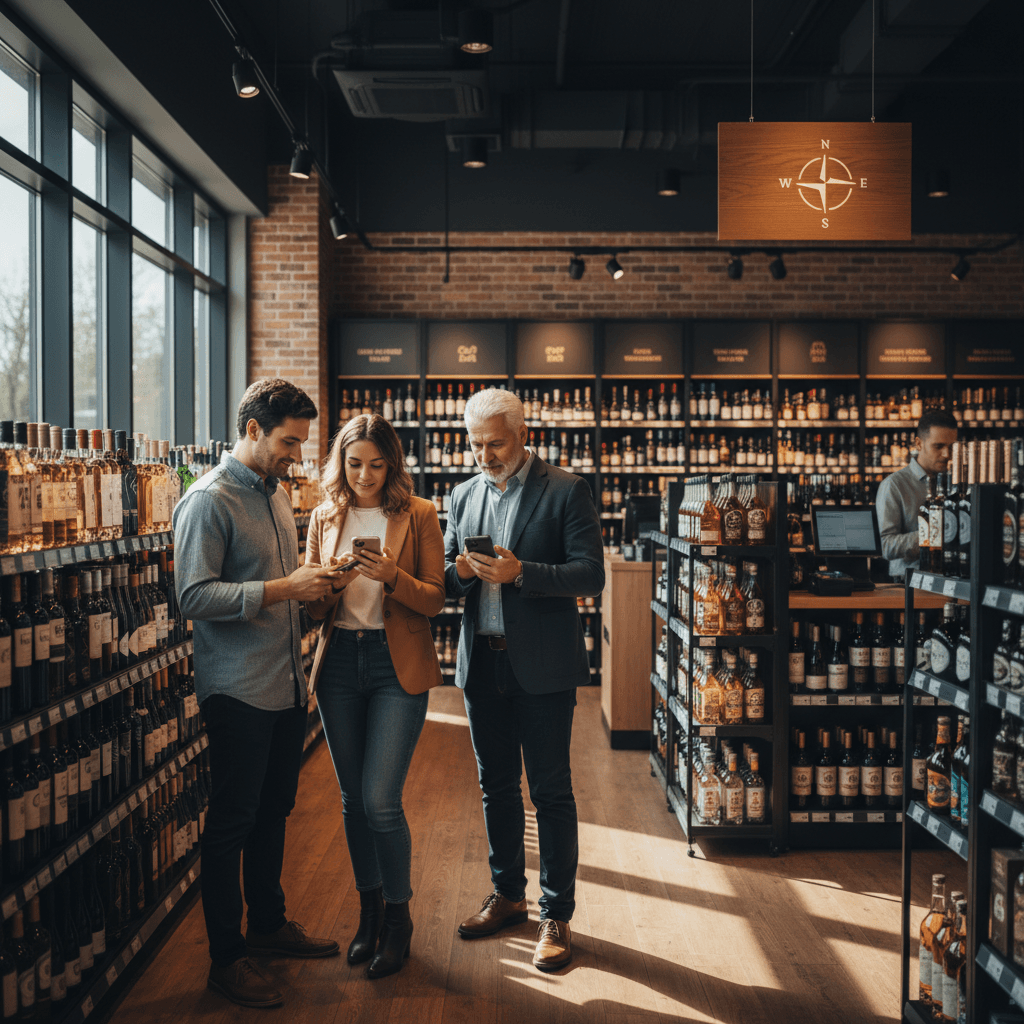
The 2025 Guide to Geofencing for Liquor Stores: Target Customers Within Miles of Your Shelves
By Intentionally Creative, Editorial Team13 min read
Listen to this article16:43
Schedule a free strategy call and Intentionally Creative will build a custom plan for you.
Schedule Your Free Strategy CallFree audit. No commitment.
Get a Free Audit. No commitment.
Learn how geofencing for liquor stores can drive foot traffic, outsmart competitors, and deliver measurable ROI with location-based ads in 2025.
Right now, someone is sitting in your competitor's parking lot, phone in hand, deciding where to buy a bottle of wine for tonight's dinner. What if your weekend sale ad appeared on their screen at that exact moment? That's not a fantasy, it's geofencing for liquor stores, and in 2025, it's one of the most practical, measurable marketing tools available to independent retailers.
Here's the reality most liquor store owners already feel in their gut: your customers don't plan ahead. They buy on impulse, on the way home, on a whim sparked by a weekend plan that came together thirty minutes ago. Traditional advertising, billboards, radio, even most digital campaigns, casts a wide net and hopes for the best. Geofencing flips that model. It targets people who are physically close enough to walk through your door, at the moment they're most likely to buy.
This guide breaks down everything you need to know, how geofencing works, how to use it against competitors, how to measure real ROI (not vanity metrics), and how to stay on the right side of tightening privacy regulations. Whether you're running a single neighborhood shop or managing multiple locations, you'll walk away with a concrete playbook you can put into action this month.
Here's the simplest way to think about it: geofencing means drawing an invisible line around a real-world location, your store, a competitor's parking lot, a nearby event venue, and serving ads to people's phones the moment they cross that line.
No app download required on their end (they just need location services enabled on apps they already use). No complicated setup on yours. Just targeted, location-triggered advertising that reaches consumers when they're physically close enough to act.
A geofence is a virtual boundary set around a GPS coordinate. When someone carrying a smartphone enters that zone, they become eligible to see your ad, whether that's a display banner, a push notification through a partner app, or a social media placement.
Avoid these common geofencing mistakes liquor stores make. Learn how to use geofencing as a liquor store to drive foo...
Most campaigns target a one- to five-mile radius around your store, which means you're not paying to reach someone three states away who'll never walk through your door. You're reaching the person driving past your shopping center right now, deciding where to stop.
That's geofencing at its most practical: spend money only on people who can actually buy from you today.
Think about how people buy liquor. It's almost never planned weeks in advance. It's "we need something for tonight," "grab a bottle on the way home," or "what pairs with what we're grilling?" Purchases are local, impulse-driven, and occasion-based, exactly the buying behavior that location-triggered ads are built to capture.
Unlike e-commerce brands burning budget on national campaigns, you have a massive structural advantage: your customer has to come to a physical store. Geofencing bridges the gap between a digital ad impression and a person walking through your door, receipt in hand.
This isn't theoretical. This is the shortest line between your ad spend and your register.
Stop leaving online sales on the table. Here are the 10 most costly e-commerce mistakes liquor stores make and how to...
Geofencing sounds technical. It's not, at least not from your side. Here's exactly how it works, broken into the pieces that actually matter for your store.
You start by drawing a boundary on a digital map. That's your geofence. Most campaigns cover a one- to five-mile radius around the store, though you can shape that zone however you want, around your shop, a competitor's location, a nearby event venue, or an entire neighborhood.
When a potential customer's phone crosses into that boundary (with location services enabled), your ad becomes eligible to serve. You're not tracking anyone. You're simply saying, "If someone is here, show them this."
It's worth noting: the regulatory landscape around location data is tightening. Google ended support for geofence warrants in late 2023, signaling a shift in how major platforms handle location information. For liquor retailers, this means working with reputable ad platforms that handle data responsibly, which any good partner will do by default. (More on compliance below.)
From the customer's perspective, there's nothing creepy happening. They're scrolling through a weather app, reading a news article, or checking game scores, and they see a clean, relevant ad. Maybe it's your weekend bourbon deal. Maybe it's a new craft tequila you just stocked. The experience feels natural because the ad is timely and local.
8 budget-friendly liquor store local advertising ideas to boost foot traffic. Proven strategies from successful retai...
That's the power of location-based targeting for liquor retailers: relevance without intrusion.
Here's where things get genuinely powerful. You don't have to rely on geography alone.
Say there's a concert venue two miles from your store. You layer event targeting on top of your geofence, now you're reaching concertgoers who are already nearby and likely in a buying mood. Add zip-code targeting to focus spend on neighborhoods with demographics that match your best customers, and you've dramatically cut wasted impressions.
A practical example: It's Friday at 3 PM. You set a three-mile geofence around your store, layer in zip codes with high household income, and push a weekend spirits promotion, maybe 15% off premium whiskey. Your ad reaches people who are close, likely heading home, and already thinking about the weekend. The right message, the right place, the right moment.
No billboards hoping for the best. No radio spots reaching three counties. Just targeted, measurable campaigns that put your store in front of customers who can actually walk through your door.
Here's a scenario: someone pulls into your competitor's parking lot, phone in hand, ready to buy. What if your ad, featuring your weekend bourbon sale or exclusive craft spirits lineup, popped up on their screen right at that moment?
That's competitor geofencing in action. You draw a virtual boundary around a rival's location, and when a potential customer's device enters that zone, they become eligible to see your ads. You're reaching people who are already in a buying mindset, they've made the decision to purchase. Your job is simply to redirect where.
And yes, it's completely legal. You're targeting a geographic area, not accessing anyone's private data. That said, work with a reputable advertising partner who stays current on compliance, the scrutiny around location data isn't letting up.
For competitor geofencing, you'll tighten your radius significantly, sometimes to just a few hundred feet around a specific address. Your ad platform (whether a DSP or specialized provider) lets you define these zones precisely.
Be honest with yourself here. Competitor geofencing works best when you have a clear differentiator, better selection, lower prices, exclusive products, a loyalty program they can't match. Pair it with a strong, time-sensitive offer that gives shoppers a genuine reason to change course.
Without that differentiator? You're essentially spending ad dollars to remind people that your competitor exists while they're already standing inside. Not exactly the ROI play you're looking for.
Geofencing isn't just about catching someone driving past your front door. The real opportunity? Using location-based targeting to move high-margin products, the bottles that actually grow your business.
Draw a geofence around affluent zip codes and serve ads for that new allocated whiskey release or an exclusive curated tasting event. You're not waiting for foot traffic, you're creating demand among buyers with the disposable income for small-batch bourbons and aged spirits.
This kind of targeted advertising positions your shop as a destination, not just a convenience stop between errands.
Here's where it gets strategic. Geofencing can power supplier-funded promotions and brand activations. Running a geo-targeted campaign for a premium tequila launch? That's exactly the kind of initiative that gives you leverage to negotiate co-op advertising dollars with distributors.
You bring the local audience targeting. They bring the budget. Your store becomes the activation venue, and everybody wins.
Location data is powerful, and that's exactly why regulators are paying closer attention to it than ever. If you're investing in geofencing for liquor stores, you need to understand the shifting rules of the road.
In late 2023, Google ended support for geofence warrants, court orders that compelled the company to hand over data on every device in a given area. That decision wasn't just about law enforcement. It signaled a fundamental shift in how major platforms handle location data, and it directly affects the tools available for location-based advertising.
Meanwhile, recent reporting has revealed that state and local law enforcement agencies, including in Texas, have invested heavily in phone-tracking software, underscoring just how sensitive this data has become. The regulatory spotlight is bright, and it's not dimming anytime soon.
The takeaway for liquor retailers? The cheap, no-name vendor promising hyper-targeted ads at bargain prices is a liability, not a deal.
Here's your practical compliance checklist:
Here's the reframe worth remembering: stores that handle geofencing with privacy built in don't just avoid fines, they build customer trust. And trust, in a competitive local market, is a real advantage. The stores cutting corners? They're one regulatory action away from reputation damage they can't undo.
Let's be honest: if you've worked with a digital marketing agency before, you've probably sat through a report full of impressions, reach, and click-through rates that meant absolutely nothing to your bottom line. You're not alone. Most liquor store owners have been burned by vanity metrics that look great on a slide deck but don't put a single extra customer in front of your register.
Geofencing for liquor stores changes that equation, and it's one of the few digital tactics where you can genuinely tie ad spend to bodies in the store.
The real power here isn't just targeting, it's foot-traffic attribution. Here's how it works: when someone inside your geofence receives an ad and later walks into your store, that visit gets tracked and attributed back to the campaign. You're not guessing whether your ads worked. You're measuring it.
Since you're targeting people within a few miles of your location, the connection between seeing an ad and making a trip is short and measurable. Context-rich promotions, think a Friday afternoon bourbon deal pushed to someone near your store, can be evaluated on store visits and redemption rates, not just clicks.
Forget impressions-only reporting. Focus on these:
Location-based advertising finally gives you a feedback loop that makes sense: spend money, measure visits, adjust, repeat. That's ROI you can take to the bank, not to a PowerPoint.
Intentionally Creative specializes in geofencing strategies that drive real results. Let us show you what's possible.
Schedule a CallYou don't need a massive budget or a marketing degree to start running location-based ads. You need a plan, a modest investment, and the discipline to measure what happens.
Pro tip: Test one competitor geofence alongside your own store fence. Comparing performance between the two tells you whether you're better at pulling new customers or re-engaging existing ones.
Most liquor retailers start testing geofencing with $500, $1,000 per month. That's enough to generate meaningful data without betting the store on an unproven channel. The key is measuring before you spend more, scale what works, cut what doesn't.
If you want help setting up a campaign built around your store's goals and geography, Intentionally Creative can walk you through it. No long-term contracts, no jargon, just results you can see in your foot traffic.
Geofencing for liquor stores isn't a shiny marketing experiment, it's a practical, measurable way to put your store in front of customers who are close enough to buy right now. In an industry where purchases are impulse-driven, occasion-based, and almost always local, the ability to reach someone within miles of your shelves at the exact right moment is a genuine competitive edge.
You don't need to overhaul your marketing strategy overnight. Start with a single geofence around your store, run a compelling offer for 30 days, and measure the foot traffic. Let the data tell you what to do next. That's it, no guesswork, no bloated ad spend, no reports full of numbers that don't connect to your register.
The stores that win in 2025 won't be the ones with the biggest budgets. They'll be the ones that reach the right customer, in the right place, at the right time, and can prove it worked.
Ready to draw your first geofence? Get in touch with Intentionally Creative and we'll build a campaign around your store, your market, and your goals. More customers through your door, that's the only metric that matters.